Preserving

Canning Peaches, Pears, and Appricots

posted by Andrea | 08/25/2011 | 6 comments

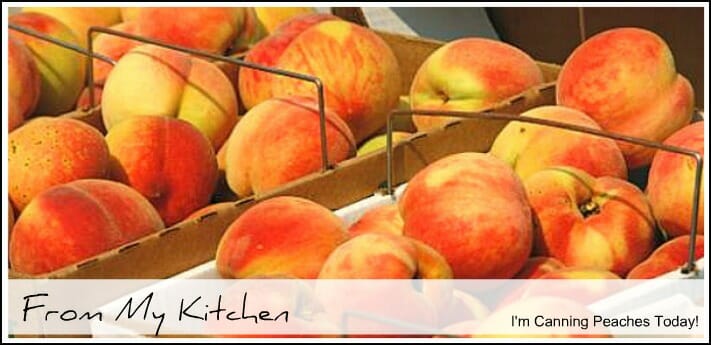
My mom and I have been canning peaches all morning {33 quarts total}… and we’re just about finished!

I know I’ve said this before, but canning really is pretty easy! Yes, it takes time and effort; yes, you make a bit of a mess; yes it’s more difficult than buying store-bought canned peaches — but if you’ve ever tasted home-canned peachesyou know that it is totally worth it!

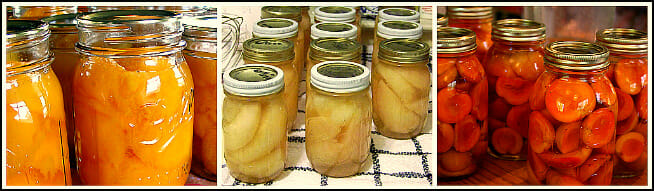
So, if you are thinking about canning peaches — or anything else this fall, let me just encourage you to give it a try! I’m hoping to post more  about my canning adventures throughout the fall months, but for now, I thought it might be helpful if I re-posted the following article from last September. It’s all about canning peaches, pears, and apricots {which are all in season, or soon to be in season, here in Michigan}.

And here’s a link to another post about getting ready for canning season.

Happy Canning!!


I don’t think there is anything more delicious than opening up a can of homegrown, home-canned fruit in the middle of winter. There is just something about it that tastes even better than fresh fruit — but that might be the added sugar!

If you’ve never tried to can your own fruit, now is a great time to start. There is still plenty of time to pick up some fresh produce from a local farmer’s market or u-pick farm — and I guarantee it’s easier than you might think.

As always, my advice for beginners is to START SMALL!

Start with a half bushel of fruit. This should be plenty for 10-12 jars of fruit plus extra to eat. Also, by starting with a half bushel, you can probably finish the job in 2-3 hours.

Equipment:

  • Water-bath canner
  • 10-12 Quart-size canning jars (I like to use wide-mouth if possible)
  • 10-12 Rings and lids
  • canning kit is also nice to have. It includes a funnel, jar tongs, magnetic lid lifter, and a few other handy tools.
  • Several towels and rags
  • 9×13″ containers to hold the peelings
  • Good pairing knife
  • A friend — to make the process go a bit quicker!

Ingredients:

  • Fruit: a half bushel should be enough for at least 10 jars plus extra to eat
  • Sugar: anywhere from 3-10 cups; depending on how heavy you like your syrup

Directions:

1. Wash fruit thoroughly:
For peaches and apricots, I wear rubber gloves and vigorously rub them under very hot water. This loosens the skins and makes them much easier to peal.

If your fruit isn’t quite ripe, simply lay out sheets of newspaper on a cement floor, spread out your fruit and cover with additional sheets of newspaper. It should ripen within 2 or 3 days.

2. Peal, halve, and pit your fruit: This is when it’s nice to have a helper!

3. Place each half into a quart jar: cut-side down,nesting to them together

4. Make a Simple Syrup: this recipe is for 7 quart jars (there is room for 7 jars in a canner)
In a medium saucepan, mix desired amount of sugar with 7 cups of water. Stir sugar/water mixture until sugar is dissolved and mixture is bubbly

  • Light syrup = 2.5 cups sugar to 7 c. water (this is what I use)
  • Medium syrup = 4 c. sugar to 7 c. water
  • Heavy syrup = 7 c. sugar to 7 c. water

5. Ladle syrup over the fruit: leave a 1/2 inch headspace.

6. Seal jars with sterilized lids and rings: make sure you wipe the tops of  the jars first

7. Process jars for 25 – 30 minutes: in a water-bath canner (it usually take 20-30 minutes to come to a full boil, at which point you should set your timer for 25 minutes)

8. Cool and seal jars: remove jars from the canner and allow to cool on a towel for 12 to 24 hours. Make sure each jars seals. (you’ll hear a ‘pop’ and the middle of the lid will be slightly indented)

9. Wash and Store: Remove the rings and thoroughly wash the jars and rings in hot soapy water (they will be very sticky).  Label each jar and store in a cool, dry place.

10. Enjoy all year round!


See, I told you it wasn’t that bad!

I know if may seem a bit overwhelming at first, but once you try it a time or two, it will seem like second nature.

What are your favorite ways to preserve fresh fruit?

?

Filed under: From My KitchenPreserving

Getting Ready for the Canning Season

posted by Andrea | 06/2/2011 | 15 comments


Once June rolls around, my mind immediately starts thinking about canning and preserving all the many fruits and vegetables that will soon be available across West Michigan.

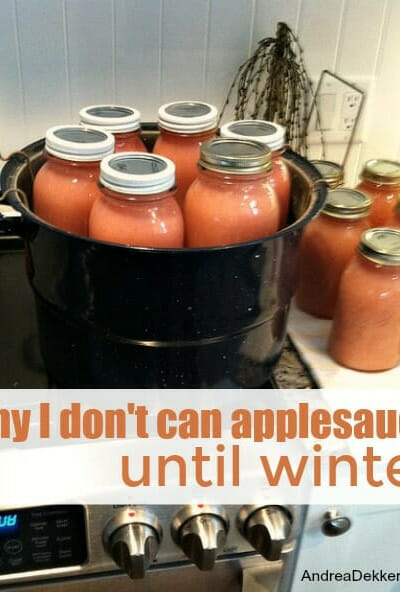
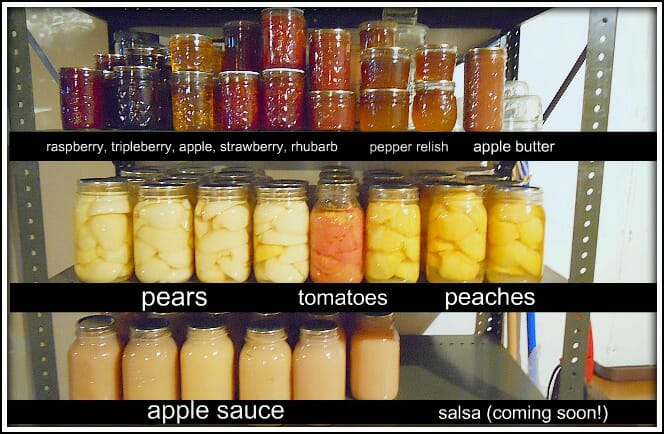
My stockpile is running pretty low {the picture above is from last summer} so I’ll most likely be doing a good amount of canning this summer and fall — don’t worry, I’ll share my progress and the delicious recipes!

However, right now, I want to focus on gearing up and getting ready for the canning season — because as you probably know, canning and preserving does take a some organization. It’s not difficult or complicated, I guarantee you can do it, but planning ahead will make is SO much easier and more enjoyable.

source:

1. Decide what you want to preserve:

:

Do you love bread and butter pickles? Have you always wanted to preserve cherries, salsa, tomatoes, or a certain type of jam?  If so, then put those things at the top of your list.

I like to make my list from the most important to the least important. For example, I only have a few jars of applesauce left so I will definitely need to put that at the top of my list. I’m also running low on salsa, tomatoes, and raspberry jam. I would love to can cherries and apricots, but those are at the bottom of my list but we don’t “need them” this year.

NOTE: If you’ve never done any canning before, I would suggest starting with jam. It’s one of the easiest and cheapest foods to can… especially if you can get free berries!

Here are a few of my favorite jam recipes — and here’s a microwave jam recipe that you can make in just about 30 minutes!


source:

2. Figure out when the produce is available:

:

Unfortunately, I can’t tell you exactly when the produce in your area will be available because so much depends on the weather, the natural climate for your area, and even the actual farms.

One good suggestion is to look in your local paper’s Classified Ads because there is usually a “Food” section. Once you start seeing specific fruits and veggie popping up in the Classified Ads, you know it’s available!

Another idea is to search for local orchards or farms in your area and simply ask them when the produce will be available.

One reason it’s important to know when the produce is available is because some of the growing seasons are very short. Last year, the strawberry season in Michigan was only a few weeks, but I could get fresh apples well into the fall and winter months. So I made sure to do strawberries right away and saved apples for when I was less busy.


3. Research where you will get your produce:

:

Will you grow your own, buy from a farmer’s market, get it directly from the farm, or purchase it from the store?

Obviously, the cheapest option is growing your own and the most expensive option is purchasing it from a grocery store, but any form of produce will work.

Yesterday, I talked about all sorts of free summer activities for kids — and if you’re looking for one more, why not find a local U-Pick farm and head out for the morning to pick your own fruit. This is a very economical way to acquire mass amounts of produce and it really doesn’t take as long as you might think. Visit PickYourOwn.org to find U-Pick farms in your area.


source:

4. Make a date:

:

Once you know WHAT you want to preserve, WHEN that produce is available, and WHERE you will get it from; then you need to decide on a specific date…and make sure to set that date aside.

For example, I’ll be picking strawberries from a local U-pick farm in a few weeks and the plan is to come right home and start washing and mashing that same day! By the end of the day, I’ll have several of jars of fresh strawberry and strawberry-rhubarb jam.

One thing I really want to stress, is you want to preserve the fruit as soon as possible after you pick it — this locks in more flavor and nutrients.


source:

5. Enlist some help:

:

At first, the whole canning process can be a bit overwhelming — but I promise it’s a lot easier with some help.

When I first got married and started canning “on my own” I asked my mom to help me the first few times. Now, a few years later, I can easily do it by myself, but it’s still really nice to have  a little help. So thankfully between my mom, mother-in-law, my grandma, and even Dave {sometimes} I almost always have an extra set of hand to peel, stir, chop, fill jars, or whatever else I need.


source:

6. Gather your supplies:

:

If you’ve been canning for a while, you probably have everything you need {except the fruit}. If you’re just starting out, you might have to purchase a few things up front; but don’t worry, you’ll be able to reuse them over and over again.

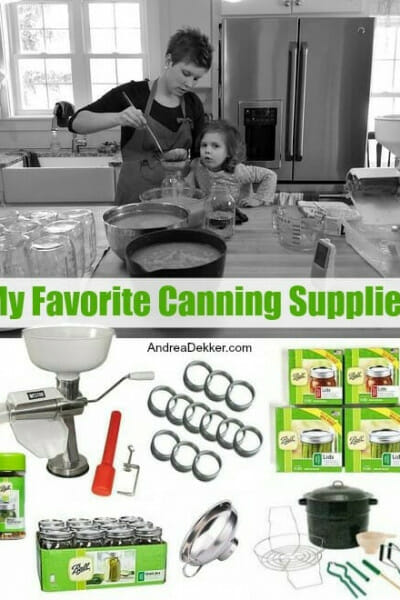
Here’s a very basic list to get you started {and you might be able to find some of these things at garage sales}

  • Canning Jars — there are so many different sizes to choose from
  • Rings & Lids
  • A Canner
  • A few handy tools like a funnel, tongs, etc — I like this 7-piece kit
  • Large pans, bowls, spoons, spatulas, strainers, etc
  • Lots of towels and rags to clean up!

You may also want to ask a friend or relative if you can borrow some of their equipment before you make a large investment.


7. Be realistic:

:

Even if you are a seasoned “canner” it’s still wise to be realistic with the amount of time and resources you have available. Canning is definitely NOT as difficult or as time consuming as most people think, but it still requires a chunk of focused time — or many chunks of focused time, depending on how many different foods you want to preserve.

Every year I make my list of foods I want to preserve and every year, there are always a few things that I don’t follow through with. Life happens, we get busy, we go on vacation, or something else comes up and then it’s too late. Oh well, there’s always next year… right?


Here are some of the recipes and resource I’ve posted already:

I’ll hopefully be adding several more to this list over the next few months!


Will you do any canning this year? What items are on your list?


Filed under: From My KitchenPreserving

Simple Microwave Jam – You Can Do This!

posted by Andrea | 03/12/2011 | comment

Yes, I know…it’s only March and fresh berries aren’t even close to “in season” — at least not in Michigan. However I did see the very first batch of rhubarb at the store today…spring is almost here!

Even so, it’s still possible to make a small batch of homemade jam TODAY. I guarantee you can do this!

Recently, I came across another way to make really small batches of jam in the microwave {yes, the microwave} …and it only takes a small amount of berries and less than 30 minutes!

The whole process is relatively simple, you really don’t need any traditional canning equipment, and you can use frozen berries from your local supermarket or your freezer.

source


Simple Microwave Jam

Makes about two 8-oz. jars — you can try any fruit combos you like by following the recipe below. 

Ingredients:

{print recipe}

  • 2-1/2 c. mashed fruit {either fresh or frozen}
  • 1 T. lemon juice
  • 2 T. powdered pectin
  • 2 c. granulated sugar

Directions:

1. In a large microwave-safe bowl, combine fruit and lemon juice.

2. Stir in pectin until dissolved, then stir in sugar.

3. Microwave {uncovered} on high for 2 minutes. Stir and scrape sides of the bowl.

4. Return bowl to microwave for 2 minutes. Stir and scrape sides.

5. Repeat in 1-minute intervals for another 2 to 4 minutes, or until jam froths up and thickens.

{Stir and scrape sides in between each interval.}

6. Once the jam is thick, remove from microwave.

7. Stir slowly for 2 to 3 minutes, or until foam subsides and skim off any remaining foam.

8. Ladle jam into clean jars or plastic containers and cover with lids.

9. Let rest at room temperature until set.

10. Once refrigerated, the jam should last for at least a month.


A Few Tips:

1. It’s best to use wooden or plastic spatulas, and bowls {metal is not ideal}

2. It’s best to use a 1200-watt microwave with a turntable. {If wattage is higher, cook on 70% power, or if wattage is lower, cook for longer.}

3. Follow all measurements and instructions. Making jam is a really simple process…as long as you follow the rules. It’s pretty important to measure all the ingredients carefully and cook for the right amount of time. If you do this, the jam should turn out every time.

4. As with regular jam recipes, it’s not recommended to make double or triple bathes. Simply make a singe batch, multiple times. It will turn out better this way.

5. Don’t worry about the jars sealing properly. Since this recipe makes such a small batch, you can simply store it in your fridge until it’s gone. {It should easily last for a month or more}

.

And if you’d like to try a few “traditional” jam recipes, I’ve got six delicious fruit combos and all the instructions you need.

Have you ever tried microwave jam?

?

Filed under: From My KitchenPreserving

Food Preserving Resources

posted by Andrea | 09/27/2010 | 2 comments

I’ve been in a major food preserving mode lately. Partially because I’m teaching a workshop on the subject in less than 24 hours, but also because the weather here in West Michigan is just screaming “Fall” — and fresh produce is aplenty!

I’ll be the first to admit that food preserving CAN BE overwhelming. I’ve been preserving {either by myself or helping my mom} for over 15 years and I still fell a bit of anxiety when I know a big canning or freezing day is coming up.

I often ask myself if it’s worth all the extra effort. But then when I go down into my basement in the middle of winter and see this:

… my happy taste buds tell me it was definitely worth the effort!

If you are new to food preserving or just looking for a few recipes and resources here are a few of my favorites.

1. Home-grown Tomatoes: One of the easiest {and cheapest} foods to preserve.

2. The Basics of Canning Jam: Everything you need to know to get started.

3. Berry Jams: 6 different varieties of my favorite berry jams.

4. Applesauce: My husband and I go through 50 quarts of applesauce each year!!! I usually don’t can it until January — but if you can’t wait; it’s just peeled and mashed apples with a bit of sugar and water.

5. Apple Butter: One of my favorite condiments year round…but especially in the fall.

6. Peaches, Pears, and Apricots: Want to have fresh-tasting  fruit all year long? Give these a try.

7. Jalapeño Jelly: I haven’t blogged about this yet, but here is a recipe that’s extremely similar to my own. Oh, and it’s NOT spicy at all!

8. Herb Reference Sheet: A list of common herbs, how to preserve them, and how to use them in your cooking.

9. Vegetable Freezing Chart: How to freeze and preserve a variety of vegetables from A to Z.

10. Recommended Processing Times: A handy list of processing times for canning fruits and veggies.

I’ve been busy preserving lots of food this Fall but I’m still hoping to find an excellent recipe for pumpkin butter and canned apple pie filling. If you have a great recipe let me know!

What are your favorite food preserving resources and recipes?


Linked to Top {Ten} Tuesdays

Filed under: From My KitchenPreservingTips and Tools

Peaches, Pears, and Apricots

posted by Andrea | 09/27/2010 | comment

I don’t think there is anything more delicious than opening up a can of homegrown, home-canned fruit in the middle of winter. There is just something about it that tastes even better than fresh fruit — but that might be the added sugar!

If you’ve never tried to can your own fruit, now is a great time to start. There is still plenty of time to pick up some fresh produce from a local farmer’s market or u-pick farm — and I guarantee it’s easier than you might think.

As always, my advice for beginners is to START SMALL!

Start with a half bushel of fruit. This should be plenty for 10-12 jars of fruit plus extra to eat. Also, by starting with a half bushel, you can probably finish the job in 2-3 hours.

Equipment:

  • Water-bath canner
  • 10-12 Quart-size canning jars (I like to use wide-mouth if possible)
  • 10-12 Rings and lids
  • canning kit is also nice to have. It includes a funnel, jar tongs, magnetic lid lifter, and a few other handy tools.
  • Several towels and rags
  • 9×13″ containers to hold the peelings
  • Good pairing knife
  • A friend — to make the process go a bit quicker!

Ingredients:

  • Fruit: a half bushel should be enough for at least 10 jars plus extra to eat
  • Sugar: anywhere from 3-10 cups; depending on how heavy you like your syrup

Directions:

1. Wash fruit thoroughly:
For peaches and apricots, I wear rubber gloves and vigorously rub them under very hot water. This loosens the skins and makes them much easier to peal.

If your fruit isn’t quite ripe, simply lay out sheets of newspaper on a cement floor, spread out your fruit and cover with additional sheets of newspaper. It should ripen within 2 or 3 days.

2. Peal, halve, and pit your fruit: This is when it’s nice to have a helper!

3. Place each half into a quart jar: cut-side down,nesting to them together

4. Make a Simple Syrup: this recipe is for 7 quart jars (there is room for 7 jars in a canner)
In a medium saucepan, mix desired amount of sugar with 7 cups of water. Stir sugar/water mixture until sugar is dissolved and mixture is bubbly

  • Light syrup = 2.5 cups sugar to 7 c. water (this is what I use)
  • Medium syrup = 4 c. sugar to 7 c. water
  • Heavy syrup = 7 c. sugar to 7 c. water

5. Ladle syrup over the fruit: leave a 1/2 inch headspace.

6. Seal jars with sterilized lids and rings: make sure you wipe the tops of  the jars first

7. Process jars for 25 – 30 minutes: in a water-bath canner (it usually take 20-30 minutes to come to a full boil, at which point you should set your timer for 25 minutes)

8. Cool and seal jars: remove jars from the canner and allow to cool on a towel for 12 to 24 hours. Make sure each jars seals. (you’ll hear a ‘pop’ and the middle of the lid will be slightly indented)

9. Wash and Store: Remove the rings and thoroughly wash the jars and rings in hot soapy water (they will be very sticky).  Label each jar and store in a cool, dry place.

10. Enjoy all year round!


See, I told you it wasn’t that bad!

I know if may seem a bit overwhelming at first, but once you try it a time or two, it will seem like second nature.

What are your favorite ways to preserve fresh fruit?

?

Filed under: From My KitchenPreserving

Berry Jams = ‘Berry’ Delicious

posted by Andrea | 09/27/2010 | 2 comments

Berries are my favorite foods to preserve each year.

And I can’t think of a better way to preserve delicious sweet berries than homemade jams and jellies — can you?

Not only are jams and jellies relatively quick and easy to master, they are also inexpensive to make, and far superior to any variety you can buy at your local store {if you’ve never had homemade jam, you’ll just have to trust me on this one!}

Every year, I make a variety of berry jams and in the interest of time, I’m going to share a few of my all-time favorite berry jam recipes in one post!

Before You Start:

Read over The Basics of Canning Jam which apply to all of the following recipes and prepare yourself for a sticky situation — literally!


Ingredients:

Please note, the recipes below are for cooked jam {not freezer jam}.

Also, since every recipe requires the same timing, stirring, measuring, and processing; I’ve only listed the actual ingredients for each recipe. The instructions can be found at the bottom of this post.

You will find lots more helpful information over at The Basics of Canning Jam. If you like, you may print that post and use is as a reference for all the recipes below!

Blackberry Jam:

  • 5 cups fresh or frozen, mashed fruit (about 2 quarts whole berries)
  • ONE 1.75oz package fruit pectin
  • 7 cups sugar

** Yields 7-8 cups of jam.

Blueberry Jam:

  • 4 cups fresh or frozen, mashed fruit (about 1.5 quarts whole berries)
  • ONE 1.75oz package fruit pectin
  • 5 cups sugar
  • 2 T. Lemon Juice

** Yields 6-7 cups of jam.

Boysenberry Jam:

  • 5 cups fresh or frozen, mashed fruit (about 2 quarts whole berries)
  • ONE 1.75oz package fruit pectin
  • 7 cups sugar

** Yields 7-8 cups of jam.

Raspberry Jam:

  • 5 cups fresh or frozen, mashed fruit (about 2 quarts whole berries)
  • ONE 1.75oz package fruit pectin
  • 7 cups sugar

** Yields 7-8 cups of jam.

Strawberry Jam:

  • 5 cups fresh or frozen, mashed fruit (about 2 quarts whole berries)
  • ONE 1.75oz package fruit pectin
  • 7 cups sugar
  • 3 T. Lemon Juice

** Yields 8-9 cups of jam.

Triple-berry Jam:

  • 2.5 cups fresh or frozen, mashed strawberries (about 3 pints whole berries)
  • 1.5 cups fresh or frozen, mashed red raspberries (about 1.5 pints whole berries)
  • 1 cup fresh or frozen, mashed blackberries or blueberries (about 1 pint whole berries)
  • ONE 1.75oz package fruit pectin
  • 7 cups sugar
  • 1 T. Lemon Juice

** Yields 8-9 cups of jam.


Instructions:

{Printable instructions and recipes}

Prepare Equipment:

  • Sterilize jars, lids, and rings
  • Place 7-10 jam jars in your sink and fill each jar with boiling water (you will probably have 1 or 2 extras)

Prepare Ingredients:

  • Wash and crush berries in a large bowl using a potato masher
  • Measure EXACT amount of mashed fruit into a 6-8 quart saucepan
  • Stir in lemon juice (if called for)
  • Stir in 1 box of fruit pectin
  • Measure EXACT amount of sugar into a SEPARATE bowl; set aside

Cook:

  • On high heat, bring fruit mixture to a full rolling boil, stirring constantly with a wooden spoon
  • Quickly stir in sugar ALL AT ONCE
  • Return mixture to a full rolling boil for 1 minute, stirring constantly
  • Remove mixture from heat and skim off any foam from the top (this is not necessary, it just makes the jam look prettier!)

Fill & Flip Jars:

  • Taking one jar at a time; quickly pour boiling water out of jam jar and ladle the hot jam into the jar
  • Fill each jar to within a 1/2 inch of the top
  • Place a sterilized lid on each jar and seal it with a ring
  • Turn jars up-side-down and let sit for 5 minutes
  • After 5 minutes, flip jars over and wait for them to seal (you’ll hear a “pop” and the center of the lid with be indented a bit)

Store:

  • Let jars sit on your counter for at least 24 hours to make sure they all seal
  • Remove the rings and wash every jar
  • Label each jar with the contents and the year
  • Store in a cool, dry place (the jam should stay good for several years —  if it lasts that long)
  • Print off these Free Printable Jam Tags and give your homemade deliciousness as a gift!
  • If a jar doesn’t seal, you can put it in the freezer — or store it in the fridge to eat.

Your Finished!

See it wasn’t THAT bad, was it?

Jams and jellies are some of the easiest foods to preserve and are SO worth the effort!

Do you have a favorite berry jam recipe?

Filed under: From My KitchenPreserving

Apple Butter

posted by Andrea | 09/27/2010 | 5 comments

Have you ever tried apple butter? If not, you are missing out on one of life’s greated condiments! OK, well maybe that’s a little extreme, but take it from someone who loves apples as much as I do — which is a lot — this recipe is to die for!

If you’ve never tried apple butter, let me inform you about it’s deliciousness:

  • To date, this is the best recipe I’ve found.
  • There is no butter in Apple Butter!
  • Apple butter gets it’s name from it’s silky-smooth, buttery consistency {or so I’m told}
  • Apple butter is very versatile; I use it on everything from toast and bagels to ham sandwiches, pork chops, and even pork tenderloin.
  • It makes great gifts, especially packaged with a loaf of cinnamon bread.
  • It’s really easy to make…but it does take lots of stirring.

Fall is the perfect time of year to make this delectable treat —  and if you keep your windows closed, your house will be filled with the sweet smell of apples and cinnamon for the next few days!

Ingredients:

  • 4 lbs. of good cooking apples (I like using Granny Smith, Gala, or a mixture of apples)
  • 1 c. apple cider vinegar
  • 2 c. water
  • 4 c. sugar (approximate — see #3 below)
  • Dash of salt
  • 2 t. cinnamon
  • 1 t. allspice
  • 1/2 t. ground cloves

Directions:

1. Wash and quarter apples (no need to peal or core them). Put apples in a large pot with vinegar and water. Cover and bring to a boil; reduce heat and simmer for 20 minutes or until apples are very soft

2. Ladle apple mixture into a foodmill or chinois sieve. Collect apple puree in a large bowl or container.

3. Measure the puree and add 1/2 cup of sugar for every 1 cup of apple puree. Stir to dissolve sugar.

4. Add salt, cinnamon, allspice, and cloves. Taste and adjust spices as necessary.

5. Cook mixture uncovered in a large, wide pan; stirring to make sure the bottom doesn’t burn. {You’ll probably have to stir for about at least an hour, or until it gets nice and thick}

6. Ladle mixture into hot, sterilized jam jars using the “Fill & Flip Method” (or you can freeze the jars)

Fill & Flip Method:

  • Fill several jam jars with boiling water; allow them to sit for a few minutes
  • Taking one jar at a time; quickly pour boiling water out and ladle the hot apple butter into the jar
  • Fill each jar to within a 1/2 inch of the top
  • Place a sterilized lid on each jar and seal it with a ring
  • Turn jars up-side-down and let sit for 5 minutes
  • After 5 minutes, flip jars over and wait for them to seal (you’ll hear a “pop” and the center of the lid with be indented a bit)

7. Let the jars sit for 24 hours, then wash and label them and store in a cool dry place for as long as they lasts — which won’t be long!

A Few More Resources:

If you are looking to “cut a few corners” to make the process go a bit quicker, here are a few other recipes you can try out. However, I can’t guarantee they will be as delicious as my recipe!

What is your favorite way to eat apple butter?

Filed under: From My KitchenPreserving